
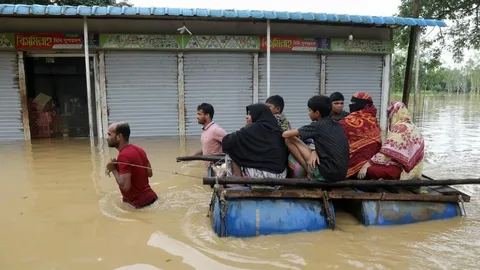
Exceptionally heavy monsoon rains arriving nearly six weeks earlier than the historical seasonal average have triggered catastrophic flooding across northeastern and central Bangladesh, submerging thousands of villages and forcing more than three million people from their homes in what meteorologists and disaster management officials are describing as among the most severe early-season flood events the country has experienced in recorded history. The Brahmaputra and Meghna river systems both exceeded their highest-ever measured water levels at multiple gauge stations simultaneously — a hydrological convergence that overwhelmed protective embankments engineered for substantially lower peak flows.
Aerial assessments conducted by Bangladesh’s Disaster Management and Relief Division showed entire districts standing under one to three meters of water, with road and rail connections severed across wide areas of Sylhet, Mymensingh, and Cumilla divisions. Crop damage assessments are still preliminary, but agricultural ministry officials warned that early estimates suggest the flooding may have destroyed a significant portion of the pre-harvest boro rice crop — one of the country’s most important food production cycles — across an area exceeding five hundred thousand hectares.
Rescue operations are being conducted using military helicopters and navy patrol boats repurposed for humanitarian use, supplemented by thousands of volunteer boats mobilized through community networks. Temporary shelter facilities established in schools, colleges, and elevated government buildings are already operating beyond intended capacity, raising urgent concerns about sanitation conditions and the potential for waterborne disease outbreaks in densely crowded evacuation sites.
International humanitarian organizations including UNICEF, the World Food Programme, and the International Federation of Red Cross and Red Crescent Societies issued emergency funding appeals and began repositioning pre-positioned relief stocks from regional hubs. The government of Bangladesh formally requested international assistance through the UN’s emergency coordination mechanism, the first such formal request in over a decade.
Climate scientists noted that the early monsoon onset and intensity are consistent with modeled projections for the Bay of Bengal under warming ocean surface temperature conditions, adding urgency to calls for accelerated investment in climate adaptation infrastructure across South Asia’s most flood-vulnerable deltaic regions.


Leave a Reply