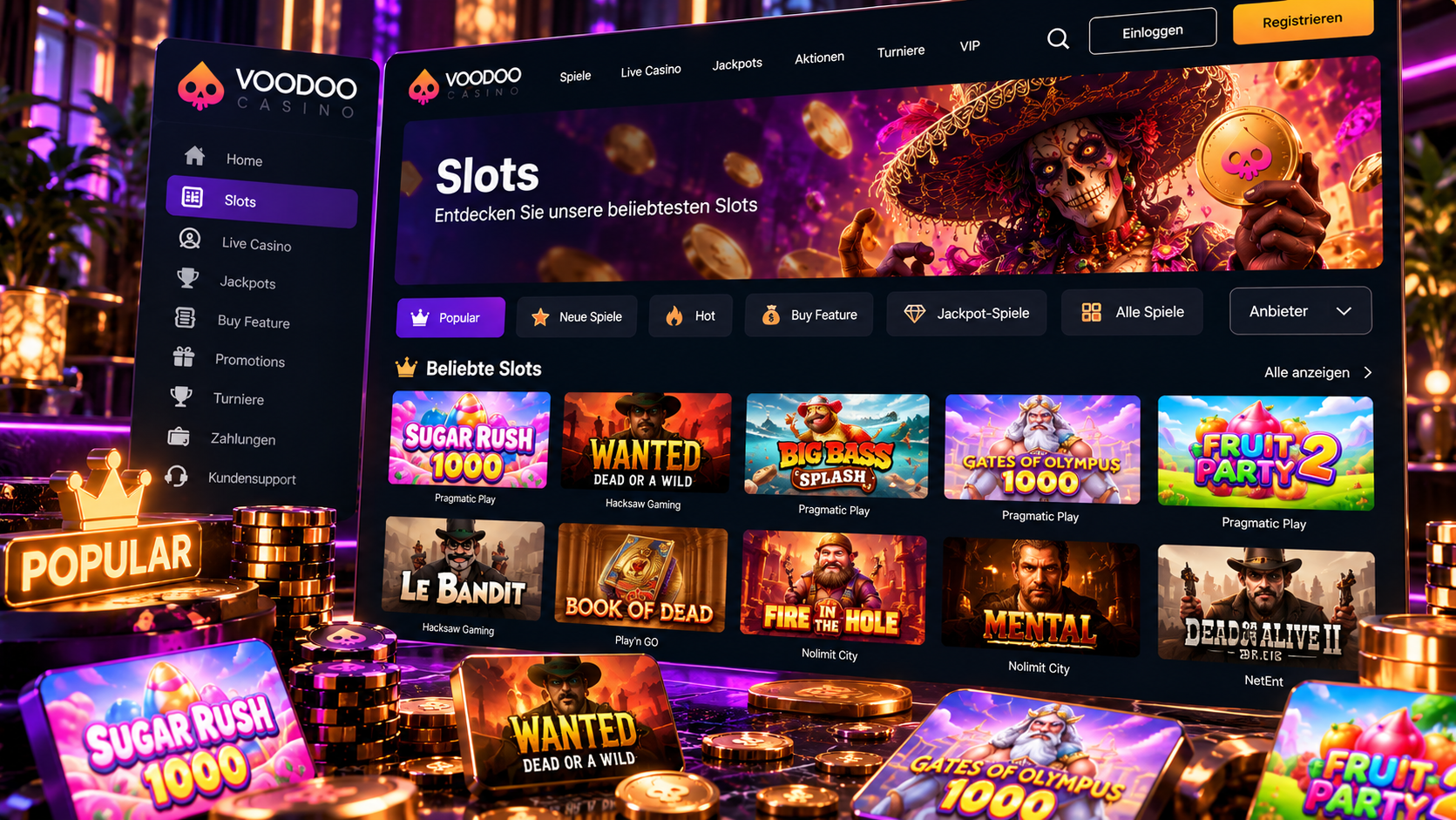
When an online casino offers a huge number of games, finding a starting point can become surprisingly difficult. A visitor may know they want to explore slots but still face hundreds or thousands of possibilities. One solution is to create a separate layer based on popularity, giving players a more focused way to browse without having to search the entire catalogue. Voodoo Casino uses this approach with its dedicated voodoo slots section, where selected games are grouped into a popular-games collection.
Turning a Huge Library Into a Smaller Starting Point
The value of a popular-games category is mainly connected to navigation. A complete casino catalogue can contain thousands of titles, while a focused section gives visitors a more manageable selection to investigate.
Voodoo’s German platform organizes its wider catalogue into several sections, including Slots, Live Casino, Jackpot Games, Buy Feature, Recommended, Hot, All Games, and Popular. This means the popular area sits within a larger navigation system rather than functioning as the only way to discover games.
That distinction is important. Popularity is one possible browsing signal, not a replacement for the complete catalogue. Visitors can still move into other sections when they want a different type of selection.
What Appears in the Popular Collection
The current popular-games interface includes a mixture of slot titles and other casino formats. The displayed selection includes games such as Hot Money Slot, Golden Joker Plus, Gold Rush with Johnny Cash, Wish And Spin Fortune, Gates of Olympus 1000, and Dr. Rock & the Riff Reactor 2. Several entries also carry labels such as “new” or “top,” adding further information to the individual game cards.
This combination creates a useful visual hierarchy. A visitor can see the game name, provider, available demo option where applicable, and additional labels without opening every title separately.
The popular section therefore works as a curated browsing surface. It does not require visitors to know a specific game name before they begin exploring.
Popularity and Recommendation Are Not the Same Thing
Modern casino interfaces often contain several sections that may appear similar at first glance. Popular, recommended, hot, and new games can all contain titles that attract attention, but they serve different browsing purposes.
A new-games section emphasizes recently introduced titles. A provider page groups games according to their developer. A recommendation section creates another curated route into the catalogue. Popular games, meanwhile, provide a way to focus on titles that have been given greater prominence within the platform’s popular category.
Voodoo keeps these sections separate on its German homepage, allowing visitors to decide what kind of discovery experience they prefer.
Provider Information Adds Context to Each Game
Another useful feature of the catalogue is the visibility of the software provider alongside individual games. The current popular selection includes titles associated with studios such as 1spin4win, Belatra, BGaming, Pragmatic Play, TrueLab, InOut, and others.
Provider information gives the visitor another piece of context before opening a game. Someone who already recognizes a particular studio can use that information to identify familiar content, while someone exploring unfamiliar providers can use the popular section as an introduction to different developers.
This becomes increasingly valuable as the overall casino library grows. Instead of treating every title as an isolated product, the interface connects individual games with the wider provider ecosystem.
Demo Options Make Browsing More Informative
Several games displayed in the popular collection include a demo button. This gives visitors an opportunity to examine supported titles before deciding whether to use them for real-money play.
A demo can provide more useful information than a thumbnail alone. Visitors can see the game’s interface, controls, visual presentation, and general structure without immediately committing funds.
At the same time, demo play should not be confused with real-money gambling. The financial circumstances are different, and game outcomes remain uncertain. Anyone considering real-money play should understand the applicable rules and risks first.
A Popular Section Can Reduce Choice Overload
Choice is one of the defining characteristics of a large digital casino, but an enormous amount of choice can also make browsing slower. A focused popular-games section addresses this by creating a smaller doorway into the wider catalogue.
Instead of asking visitors to decide between thousands of possibilities immediately, the interface gives them an alternative starting point. They can inspect a more concentrated collection and then move outward if they want to explore further.
This is similar to how other digital entertainment platforms organize large libraries. Featured and popular sections provide orientation, while search and category pages remain available for users who already know exactly what they want.
New and Popular Can Work Together
One particularly interesting aspect of the current collection is that some games carry both “new” and “top” labels. This shows that different catalogue signals can overlap.
A title does not necessarily have to belong to only one conceptual group. A recently introduced game can also receive top status, while another established title may appear because of its position within the popular collection.
For visitors, these labels provide additional context without requiring a separate research process. The game card itself communicates that the title has more than one reason for being highlighted.
The Role of Game Providers in Catalogue Discovery
Voodoo’s wider German platform lists a large number of providers, giving visitors another way to move through the catalogue. The popular section acts as a meeting point between these different studios because titles from multiple providers appear together.
This makes the section useful for comparison. Rather than opening separate provider pages one after another, visitors can encounter games from different studios within a single selection.
If a particular provider catches their attention, they can then continue exploring that studio’s broader catalogue. The popular section can therefore function as an introduction to the wider provider ecosystem.
Popularity Does Not Mean Guaranteed Results
The word “popular” describes catalogue positioning, not a promise about gambling outcomes. A title being highlighted or placed in a popular section does not mean that it offers a guaranteed return or a better chance of winning.
This distinction is important when evaluating any casino interface. Labels such as popular, hot, top, or recommended are useful for navigation, but they should not be interpreted as predictions of individual results.
Casino games remain games of chance where applicable outcomes depend on the specific rules and mechanics of the title. Visitors should consult the individual game information and rules before playing.
How a Focused Catalogue Improves the Browsing Experience
The most useful aspect of a dedicated popular section is its simplicity. It does not attempt to replace the full casino library. Instead, it gives visitors another route into it.
Voodoo’s German interface combines this route with categories for new games, recommendations, providers, jackpots, live casino, and the complete catalogue. Each section answers a slightly different browsing question.
Someone interested in recent releases can explore new games. Someone looking for a specific studio can use provider navigation. Someone who wants a smaller selection can start with popular titles. The platform therefore gives visitors control over how much of the catalogue they want to examine.
A Smaller Window Into a Much Larger Catalogue
Large online casino libraries are likely to continue expanding as new providers and releases are added. With that growth, discovery tools become increasingly important. A popular section is one way of making a substantial catalogue easier to approach without limiting access to the full collection.
Voodoo’s current popular-games area demonstrates this model by bringing together selected titles from multiple providers while preserving links to the wider catalogue. Demo options, provider labels, and additional status indicators add more information directly to the game cards.
For visitors, the result is a more focused starting point. Instead of treating thousands of titles as one enormous list, the popular section creates a smaller window into the broader gaming environment while leaving the rest of the catalogue available for deeper exploration.