
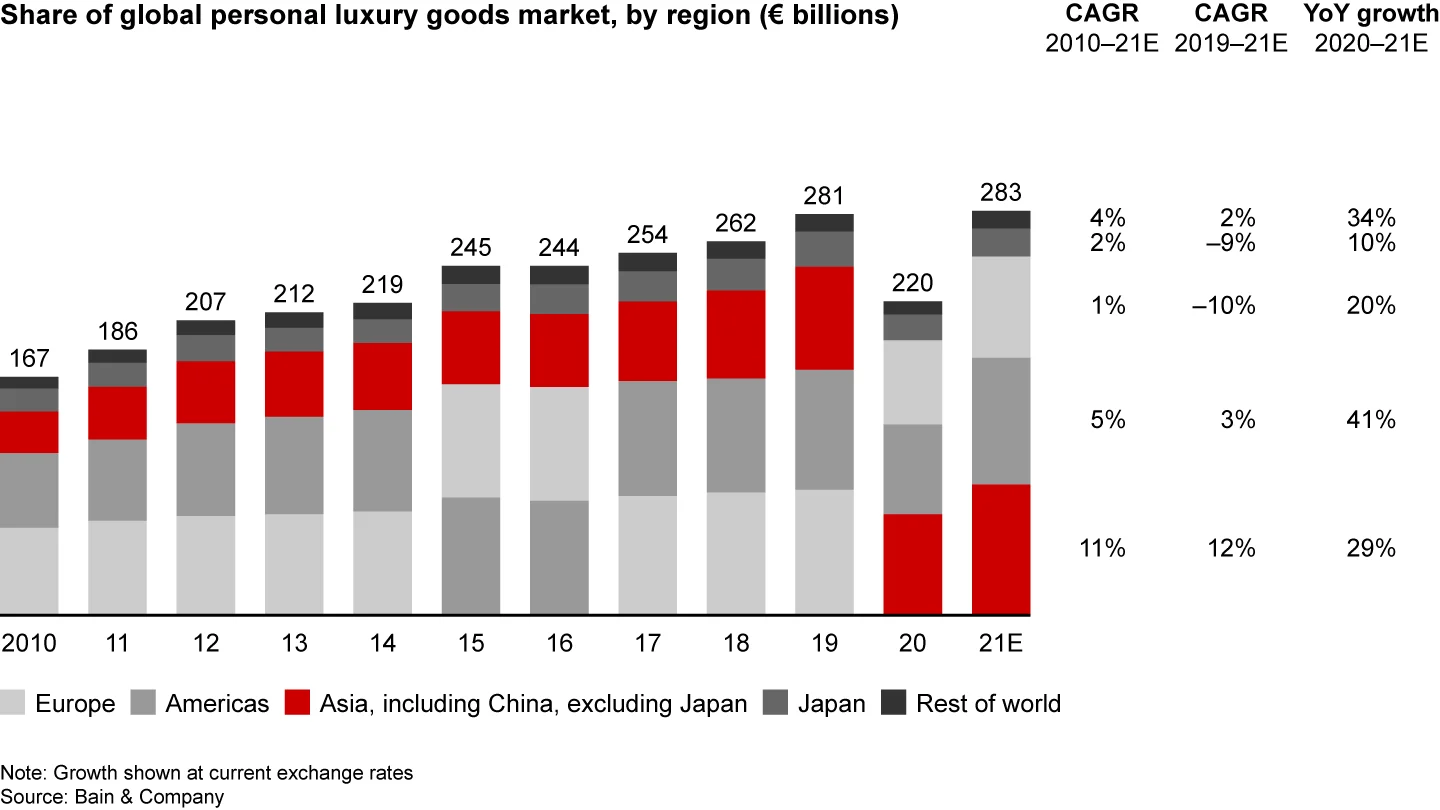
The global personal luxury goods market reached a record one point eight trillion dollars in aggregate revenue during 2025, according to the annual industry report released by Bain & Company in partnership with the Italian luxury industry federation, with growth driven primarily by expanding middle and upper-middle class consumer bases across Southeast Asia, India, and the Gulf Cooperation Council states — a geographical diversification that has substantially reduced the sector’s historical dependence on Chinese consumer spending and provided resilience against regional economic volatility.
India emerged as the report’s standout growth story, recording a forty-one percent year-on-year increase in luxury goods spending — the fastest expansion of any major market globally and a figure that reflects both the rapid expansion of India’s affluent consumer tier and significant improvements in official retail infrastructure as international luxury houses accelerate their direct-to-consumer presence in Tier 1 and Tier 2 Indian cities. Analysts project India will become the world’s third-largest luxury market within five years if current trajectories hold.
The experiential luxury segment — covering high-end hospitality, private travel, fine dining, and cultural experiences — outpaced personal goods for the third consecutive year, growing at nearly twice the rate of traditional product categories. Industry researchers attribute this to a persistent post-pandemic shift in affluent consumer preferences toward experiences over possessions, a behavioral change that appears to have become structurally embedded rather than cyclical.
The sustainability credentials of luxury brands have become a meaningful commercial differentiator, particularly among consumers under forty. Brands that have invested in verifiable supply chain transparency, recycled material integration, and credible carbon reduction commitments are consistently outperforming peers on customer acquisition metrics in younger affluent demographics, according to the report’s consumer survey component.
Counterfeit goods remain a persistent challenge, with AI-powered authentication technology and blockchain-based provenance tracking being adopted at accelerating rates across the sector as brands seek to protect both revenues and brand integrity in an era of increasingly sophisticated duplication.

Leave a Reply